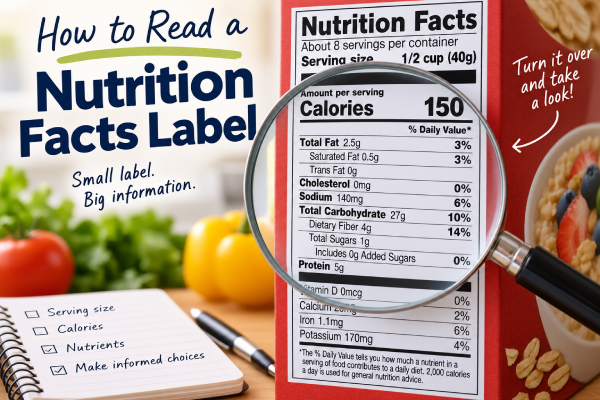
Have you ever picked up a package, turned it over, looked at the Nutrition Facts label and wondered exactly what you were supposed to be looking for?
There’s a lot of information packed into that little box.
Calories, serving size, percentages, different kinds of fat, carbohydrates, fiber, sugars, protein, vitamins and minerals are all competing for your attention.
The good news is that you don’t have to analyze every number.
Once you know where to look, a Nutrition Facts label can become one of the most useful tools you have for making informed food choices.
Start With the Serving Size
Before you look at anything else, look at Serving Size and Servings Per Container.
Everything else on the Nutrition Facts label is based on that serving size.
Suppose a package contains:
Serving size: 1 cup
Calories: 250
If you eat 2 cups, you’ve eaten two servings.
That means you’re getting approximately:
500 calories
and twice the listed amounts of fat, carbohydrates, fiber, added sugar, protein, sodium and other nutrients.
This is one of the easiest places to misread a food label.
Also remember that a serving size isn’t necessarily a recommendation for how much you should eat. It’s the amount used to provide the nutrition information on the label.
Look at the Calories
Calories tell you how much energy is provided by one serving.
If you’re tracking calories for weight management, make sure the amount you’re entering into your food tracker matches the amount you actually ate.
A 200-calorie serving isn’t 200 calories anymore if you eat two servings.
It becomes 400.
Simple as that.
Learn to Use % Daily Value
The % Daily Value, usually written %DV, may be one of the most useful parts of the entire label.
It tells you how much one serving contributes toward the Daily Value for a particular nutrient.
Fortunately, you don’t have to calculate the percentages yourself.
There’s an easy rule of thumb:
5% Daily Value or less = LOW
20% Daily Value or more = HIGH
Suppose one food contains 4% DV of saturated fat and another similar food contains 25%.
You can immediately see that the second food provides considerably more saturated fat per serving.
The same idea works in the other direction.
If you’re comparing two foods for fiber and one contains 5% DV while another contains 25%, the second is a much higher source of fiber.
Know Which Nutrients You May Want Less Of
The FDA recommends using the label to choose foods that are generally lower in:
- Saturated fat
- Sodium
- Added sugars
That doesn’t mean you have to find foods containing zero of all three.
The %DV simply gives you a way to see how much a serving contributes to your day.
If you’d like to learn more about saturated fat and added sugar, you’ll find separate Calorie Crusaders Resources devoted to both.
Total Fat Isn’t the Whole Story
You’ll see Total Fat followed by different types of fat.
These include:
- Saturated fat
- Trans fat
The type of fat matters, not simply the total amount.
That’s why it’s useful to look beyond Total Fat and check the saturated fat number too.
Our Saturated Fat Resource explains how much saturated fat is generally recommended and how it fits into an overall diet.
Don’t Overlook Sodium
Sodium deserves a look, particularly in packaged and prepared foods.
Like saturated fat and added sugar, sodium has a %DV that makes comparing foods easier.
Using the 5%/20% rule:
5% DV or less is low in sodium.
20% DV or more is high in sodium.
You may be surprised by where sodium turns up.
Foods don’t necessarily have to taste extremely salty to contain a substantial amount.
Understand Total Carbohydrate
Under Total Carbohydrate, you’ll usually find some additional information, including:
- Dietary fiber
- Total sugars
- Added sugars
Don’t assume all carbohydrates are the same.
A food containing carbohydrates from beans, whole grains or fruit is nutritionally very different from a food getting most of its carbohydrates from added sugar.
That’s why looking farther down the label is useful.
Look at Dietary Fiber
Fiber is one nutrient you generally want to get enough of.
The FDA Daily Value for fiber is 28 grams per day, based on a 2,000-calorie diet.
The %DV makes comparison easy.
If one bread provides 3% DV of fiber and another provides 15%, you immediately know which one contributes more fiber per serving.
If you’d like to know more about fiber, including how much you need and why you shouldn’t increase it too quickly, see our Fiber Resource.
Total Sugar and Added Sugar Are NOT the Same Thing
This is one of the most important parts of the label to understand.
You might see:
Total Sugars 15g
Includes 7g Added Sugars
That does not mean the food contains 22 grams of sugar.
The 7 grams of added sugar are already included in the 15 grams of total sugar.
In this example, the food contains 15 grams of sugar altogether, 7 grams of which are added sugars.
Total Sugars can include sugars naturally present in foods such as milk and fruit.
The Added Sugars line tells you how much sugar was added or otherwise counts as added sugar under labeling rules.
Our Added Sugar Resource explains this in much more detail, including why honey and syrups count toward added-sugar intake.
What About Sugar Substitutes?
You usually won’t find a line on the Nutrition Facts panel that simply says Sugar Substitutes.
If a product is sugar-free or reduced in sugar, check the ingredient list as well as the Nutrition Facts label.
That’s where you may find ingredients such as:
- Aspartame
- Sucralose
- Saccharin
- Stevia-derived sweeteners
- Monk fruit extract
- Erythritol
- Xylitol
If you’re curious about the differences among them, our Sugar Substitutes Resource takes a closer look.
Look at Protein
Protein is listed in grams.
You may notice something interesting: protein often doesn’t have a % Daily Value printed beside it.
That doesn’t mean the food contains no protein or that protein isn’t important.
For foods intended for the general population age 4 and older, the FDA generally doesn’t require a protein %DV unless the manufacturer makes a protein claim, such as calling the food “high in protein.”
So when you’re tracking protein, the number of grams is usually the most useful number to look at.
Our Protein Resource explains how protein needs are estimated and why individual needs can vary.
Vitamins and Minerals
Near the bottom of the label you’ll generally find:
- Vitamin D
- Calcium
- Iron
- Potassium
The label gives both the amount and the %DV for these nutrients.
The FDA generally encourages choosing foods that provide more dietary fiber, vitamin D, calcium, iron and potassium as part of an overall healthy eating pattern.
Again, you don’t have to find a single food that provides everything.
Your whole day’s diet matters.
Don’t Forget the Ingredient List
The Nutrition Facts panel tells you how much of various nutrients a food contains.
The ingredient list tells you what’s actually in the food.
Ingredients are generally listed in descending order by weight, so the ingredients present in the largest amounts appear first.
Looking at both the Nutrition Facts label and the ingredient list gives you a much better picture than looking at either one alone.
This can be particularly helpful when you’re comparing similar products.
Be Careful With Claims on the Front
Food packages are designed to get your attention.
You may see claims such as:
High Protein
Low Fat
No Added Sugar
Sugar Free
High Fiber
Those claims may provide useful information, but they don’t tell you everything about the food.
Turn the package around.
Read the Nutrition Facts label.
Check the serving size.
Look at the calories.
Look at the nutrients that matter to you.
And, when useful, read the ingredient list.
The information on the back of the package can tell you much more than the advertising on the front.
A Simple Way to Read Almost Any Label
If Nutrition Facts labels feel overwhelming, you don’t have to study every line.
Start with these questions:
1. What is the serving size?
2. How many servings am I actually eating?
3. How many calories does that give me?
4. Is the food high or low in the nutrients I’m watching?
5. What does the ingredient list tell me?
That’s enough to tell you quite a bit.
Use the Label as a Tool, Not a Report Card
A Nutrition Facts label isn’t there to tell you whether a food is “good” or “bad.”
It’s information.
And information gives you choices.
Maybe one food is higher in saturated fat but fits comfortably into the rest of your day.
Maybe another food has more added sugar than you expected, and you decide you’d rather spend those calories somewhere else.
Maybe you discover that a food you’ve been eating regularly is an excellent source of fiber.
That’s the real value of learning to read nutrition labels.
You don’t have to guess what’s in your food.
Turn it over and take a look.
This information is for general educational purposes and isn’t intended to replace individualized medical or nutritional advice.