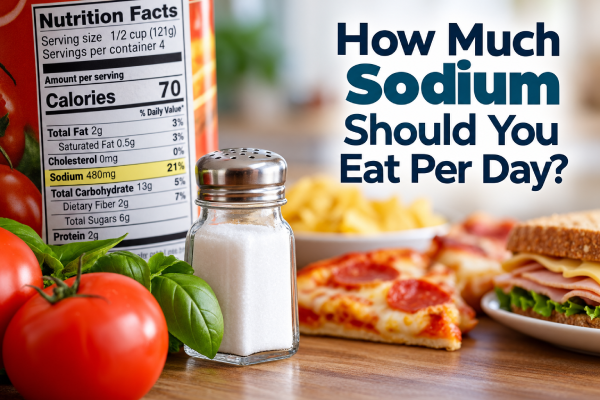
If you are trying to eat healthier, you may wonder how much sodium per day you should be eating. Sodium is something our bodies need. However, most Americans get more sodium than they need.
The good news is that you don’t have to give up flavor to keep an eye on sodium. Learning where sodium comes from is a great place to start.
How Much Sodium Do You Need?
The Daily Value for sodium on the Nutrition Facts label is less than 2,300 milligrams per day.
The American Heart Association also recommends no more than 2,300 milligrams per day. It suggests an optimal goal of no more than 1,500 milligrams per day for most adults.
Your individual needs can be different. Certain medical conditions, medications, activity levels, and other factors can affect how much sodium is appropriate for you.
If your doctor has given you a specific sodium goal, follow that advice instead of a general recommendation.
Sodium and Salt Are Not Exactly the Same Thing
We often use the words sodium and salt as though they mean the same thing. They aren’t quite the same.
Sodium is a mineral found naturally in some foods. It is also added to many foods during processing and preparation.
Table salt is sodium chloride. It contains about 40% sodium.
About one teaspoon of table salt contains roughly 2,300 milligrams of sodium.
That doesn’t mean all of your daily sodium comes from the salt shaker, though.
Most Sodium Isn’t Coming From Your Salt Shaker
This surprised me.
More than 70% of the sodium Americans eat comes from packaged, prepared, and restaurant foods.
That means you could rarely pick up the salt shaker and still eat quite a bit of sodium.
Some common sources include:
- Canned soups
- Frozen meals
- Pizza
- Sandwiches
- Deli and processed meats
- Sauces and condiments
- Packaged snack foods
- Restaurant meals
Even foods that don’t taste especially salty can contain sodium.
That’s one reason reading the label can be so helpful.
Check Sodium on the Nutrition Facts Label
The Nutrition Facts label tells you exactly how much sodium is in one serving.
You’ll see the amount listed in milligrams (mg) along with the % Daily Value (%DV).
Here’s a handy rule to remember:
5% Daily Value or less is considered low.
20% Daily Value or more is considered high.
Don’t forget to check the serving size.
If a food contains 500 mg of sodium per serving and you eat two servings, you’ve eaten 1,000 mg of sodium.
Our How to Read a Nutrition Facts Label resource explains serving sizes and Daily Values in more detail.
Compare Similar Foods
One of the easiest ways to reduce sodium is simply to compare labels.
Two cans of soup may look almost identical but have very different amounts of sodium.
The same can happen with bread, sauces, salad dressings, frozen meals, and many other foods.
You don’t necessarily have to stop buying the food. Sometimes you can just choose the version with less sodium.
What Does “Low Sodium” Mean?
Food labels can use several different sodium claims.
You may see terms such as:
- Sodium free
- Very low sodium
- Low sodium
- Reduced sodium
- No salt added
Be careful with reduced sodium.
Reduced sodium means the product contains less sodium than the regular version. It doesn’t necessarily mean the food itself is low in sodium.
That’s another good reason to turn the package around and read the Nutrition Facts label.
Easy Ways to Cut Back on Sodium
Reducing sodium doesn’t have to mean eating bland food.
Try flavoring food with:
- Garlic
- Onion
- Pepper
- Herbs
- Spices
- Lemon or lime juice
- Vinegar
You can also look for no-salt-added or lower-sodium versions of foods you already buy.
Fresh and frozen vegetables without sauces or seasonings can be good choices.
Rinsing canned beans, tuna, and vegetables can also remove some of their sodium.
And when you eat out, remember that restaurant meals can contain quite a bit of sodium. Looking at nutrition information ahead of time can help when it is available.
You Don’t Have to Be Perfect
Like so many things with nutrition, sodium doesn’t have to become an all-or-nothing proposition.
A higher-sodium meal doesn’t mean you’ve ruined your healthy eating plan.
Instead, pay attention to your overall eating pattern.
Read labels. Compare products. Make lower-sodium choices when they make sense.
Small changes can add up.
And most importantly, know what you’re eating.
That’s what Calorie Crusaders is all about.