If you’re trying to cut back on added sugar or calories, sooner or later you’re probably going to run into sugar substitutes.
They’re in diet soft drinks, sugar-free foods, yogurt, protein products, drink mixes and those little packets sitting next to the sugar bowl.
But are sugar substitutes actually a good choice?
The answer isn’t quite as simple as yes or no. There are several different kinds of sugar substitutes, and they aren’t all the same.
What Are Sugar Substitutes?
Sugar substitutes are ingredients used to provide sweetness with less sugar and, in many cases, fewer calories.
Some are hundreds of times sweeter than table sugar, so only a tiny amount is needed. Others, such as sugar alcohols, provide bulk and sweetness more like regular sugar.
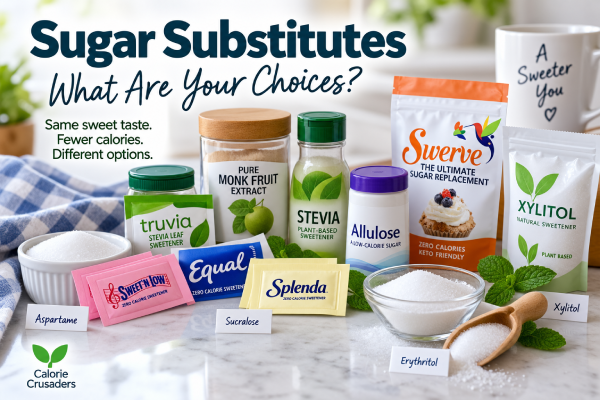
Some common sugar substitutes include:
- Aspartame
- Sucralose
- Saccharin
- Acesulfame potassium, or Ace-K
- Stevia-derived sweeteners
- Monk fruit extract
- Erythritol
- Xylitol
- Sorbitol
- Allulose
That’s quite a list, and it helps to understand that these sweeteners don’t all belong to the same category.
FDA – High Intensity Sweeteners
A Quick Look at Some Common Sugar Substitutes
| Sugar Substitute | Type | Calories | Effect on Blood Sugar |
|---|---|---|---|
| Aspartame | High-intensity sweetener | Very little | Generally little effect |
| Sucralose | High-intensity sweetener | Very little or none | Generally little effect |
| Saccharin | High-intensity sweetener | Very little or none | Generally little effect |
| Stevia | Plant-derived high-intensity sweetener | Very little or none | Generally little effect |
| Monk fruit | Fruit-derived high-intensity sweetener | Very little or none | Generally little effect |
| Erythritol | Sugar alcohol | Very low | Little effect |
| Xylitol | Sugar alcohol | Lower than sugar | Smaller effect than sugar |
| Allulose | Low-calorie sugar | About 0.4 calories per gram | Much smaller effect than regular sugar |
These differences can matter depending on why you’re using a sugar substitute.
What About Aspartame?
Aspartame deserves a section of its own because there has been controversy surrounding it for many years.
In 2023, the International Agency for Research on Cancer, which is part of the World Health Organization, classified aspartame as possibly carcinogenic to humans.
That sounds frightening, but the wording needs some explanation.
The classification was based on limited evidence and identifies a possible hazard. It doesn’t mean that eating or drinking a particular amount of aspartame has been proven to cause cancer.
At the same time, the Joint FAO/WHO Expert Committee on Food Additives reviewed the evidence and kept its established acceptable daily intake for aspartame.
The FDA also continues to consider aspartame safe when consumed under approved conditions of use and has disagreed with the conclusion that the evidence supports classifying it as a possible human carcinogen.
So where does that leave us?
Aspartame remains an approved sweetener, and major food-safety authorities consider consumption within established limits acceptable. At the same time, questions about possible health effects continue to be researched.
You don’t have to choose aspartame simply because you’re trying to avoid sugar. There are other choices available.
Are Stevia and Monk Fruit Different?
Stevia and monk fruit sweeteners are derived from plants or fruit, which makes them appealing to people looking for alternatives to artificial sweeteners.
Purified steviol glycosides used as sweeteners can be hundreds of times sweeter than table sugar. Monk fruit extracts are also considerably sweeter than sugar.
But there’s an interesting distinction with stevia.
The highly purified stevia-derived ingredients commonly used as sweeteners aren’t the same thing as whole stevia leaves or crude stevia extracts. The FDA has not objected to GRAS conclusions for certain highly purified steviol glycosides, while whole-leaf and crude stevia extracts aren’t permitted for use as sweeteners in the United States.
So even the word “stevia” can describe somewhat different products.
What About Erythritol and Xylitol?
Erythritol and xylitol belong to a group called sugar alcohols.
Sugar alcohols generally provide fewer calories than regular sugar and have less effect on blood glucose. That’s one reason they’re commonly found in products marketed as low-carb or sugar-free.
However, recent research has raised questions about erythritol and xylitol.
Studies have found associations between higher blood levels of these sugar alcohols and cardiovascular events such as heart attack and stroke. Laboratory and small human experiments have also suggested that they may increase platelet activity involved in blood clotting.
That doesn’t prove that consuming an ordinary amount of erythritol or xylitol causes a heart attack or stroke.
In fact, the FDA has specifically noted that observational research on erythritol hasn’t established a causal relationship. Researchers continue to study the issue.
For now, I think this is another good reminder that “sugar-free” doesn’t automatically mean that we should eat unlimited amounts of something.
Can Sugar Substitutes Help With Weight Loss?
They certainly can reduce calories in an individual food or drink.
If you replace a 150-calorie sugar-sweetened soft drink with a zero-calorie version and don’t replace those calories somewhere else, you’ve reduced the calories you consumed.
But that doesn’t necessarily mean using sugar substitutes will cause long-term weight loss.
The World Health Organization recommends against relying on non-sugar sweeteners as a strategy for long-term weight control. Its review didn’t find evidence of long-term benefit for reducing body fat.
WHO also describes this recommendation as conditional. The organization notes that some of the associations seen in research may be influenced by differences between people who use sugar substitutes and those who don’t.
There’s also an important distinction: WHO’s weight-control recommendation isn’t the same thing as declaring individual approved sweeteners unsafe.
Are Sugar Substitutes Better for Blood Sugar?
Many high-intensity sweeteners generally don’t raise blood glucose the way regular sugar does.
Sugar alcohols also tend to have less effect on blood glucose than traditional sugar.
That can make sugar substitutes useful in certain situations. But a food labeled “sugar-free” isn’t necessarily carbohydrate-free, calorie-free or automatically nutritious.
The rest of the food still matters.
Which Sugar Substitute Is Best?
There probably isn’t one sugar substitute that’s best for everybody.
Taste matters. How you’re using it matters. Your health and dietary needs can matter too.
Some people prefer stevia or monk fruit. Some are comfortable using sucralose or aspartame. Others would rather use a small amount of regular sugar or honey and simply count it as part of their added sugar for the day.
And that’s a perfectly reasonable option too.
Remember from our Added Sugar resource that honey may be natural, but it still contributes to added-sugar intake.
Don’t Let “Sugar-Free” Become a Free Pass
This may be the most important thing to remember.
Replacing sugar with a substitute doesn’t automatically transform a food into something nutritious.
A sugar-free cookie is still a cookie.
On the other hand, you don’t necessarily need to be afraid of every food containing a sugar substitute.
Look at the whole food. Look at the calories, ingredients and nutrients. Think about how much you’re eating and how often you’re eating it.
A sugar substitute can be one tool for reducing added sugar or calories.
It doesn’t have to be the foundation of your diet, and it isn’t a magic ingredient for weight loss.
As with so many things we’re learning on this journey, knowing what you’re eating gives you the information you need to make your own choices.
This information is for general educational purposes and isn’t intended to replace individualized medical or nutritional advice.