
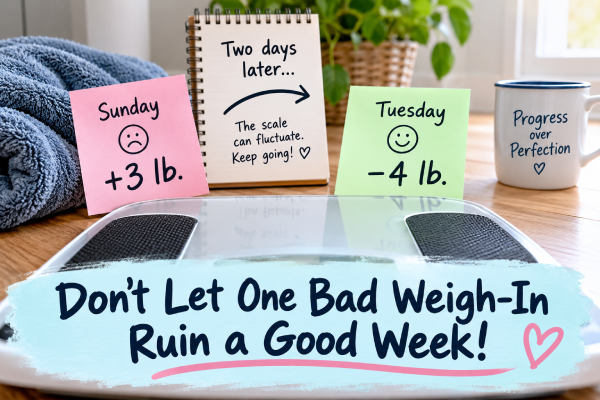
Weight fluctuations during weight loss can be frustrating. Just when you think you’re doing everything right, you step on the scale and discover you’ve gained weight. That’s exactly what happened to Glenn this week. But two days later, the scale told a completely different story!
Glenn’s Sunday Morning Surprise
Sunday is weigh-in day at our house. Glenn and I have been working on losing weight together, and we look forward to seeing how we’ve done each week.
This past Sunday, Glenn stepped on the scale and discovered he’d gained three pounds!
He was understandably disappointed. He told me he didn’t think he’d done badly with his eating during the week. He’d been counting his calories and following his plan.
I suggested that he wait a couple of days and weigh himself again on Tuesday.
And I’m glad he did!
When Tuesday morning arrived, Glenn stepped on the scale again. This time, he weighed four pounds less than he had on Sunday!
That meant he was actually one pound lighter than he’d been at his previous week’s weigh-in.
What a difference two days can make!
Why Does Weight Fluctuate So Much?
Our bodies don’t always cooperate with our bathroom scales.
There are several reasons we might weigh more on one day than another, even when we’re following our calorie goals.
- Water retention: Our bodies naturally hold different amounts of water from day to day.
- Sodium: Eating salty foods can temporarily cause us to retain more water.
- Digestion: Food and waste moving through our digestive systems affect what the scale shows.
- Physical activity: Exercise and muscle recovery can temporarily affect water retention.
- Normal body changes: Hydration, hormones, and other factors can influence daily weight.
Glenn certainly didn’t lose four pounds of body fat between Sunday and Tuesday. Most of that change was probably water weight and other normal fluctuations.
That’s why it’s important not to judge our progress by a single weigh-in.
For more information about healthy weight management, visit the National Institute of Diabetes and Digestive and Kidney Diseases.
Our Weight-Loss Goal Calculator Told a Different Story
Here’s the part I find especially interesting.
Even on Sunday, when Glenn’s scale showed a three-pound gain, our Weight-Loss Goal Calculator showed that he was still averaging a loss of 2.2 pounds per week since he started his weight-loss journey.
And Glenn is only trying to lose one pound per week!
Think about that.
He was disappointed because he’d gained three pounds according to the scale. But when he looked at his overall progress, he was still ahead of his goal.
That’s one of the reasons we created the Weight-Loss Goal Calculator.
It doesn’t just tell you how much weight you’ve lost. It also calculates your average weekly weight loss based on your starting weight, current weight, and starting date.
It helps you see the bigger picture.
Of course, even that average can change when your weight temporarily fluctuates. But looking at your progress over several weeks gives you a much better perspective than focusing on a single day.
Don’t Let the Scale Discourage You
I’ve learned something important during my own weight-loss journey.
There was a time when a disappointing weigh-in could really discourage me. I used to be quite a perfectionist about losing weight.
If things didn’t go exactly as planned, I sometimes felt as though I had failed.
But I’m learning to look at things differently.
One day of eating a little more than planned doesn’t ruin my progress. And one disappointing weigh-in doesn’t mean my weight-loss plan isn’t working.
What matters is what happens over time.
If we’re consistently following a reasonable calorie goal and making progress over the long run, we don’t need to panic every time the scale moves in the wrong direction.
We also don’t need to punish ourselves by drastically cutting calories after a disappointing weigh-in.
We just need to keep going.
Adjust your calorie intake as activity changes.
Look at the Trend, Not Just the Number
There’s nothing wrong with weighing yourself once a week. That’s what Glenn and I normally do.
But sometimes a weekly weigh-in happens to fall on a day when we’re retaining extra water.
That can give us a misleading impression of our progress.
One option is to weigh more frequently under similar conditions and look at a weekly average. Another is to continue weighing weekly while comparing results over several weeks.
The important thing is to find an approach that helps you stay informed without becoming discouraged.
And remember, losing weight faster isn’t necessarily better. Glenn’s average of 2.2 pounds per week is faster than his one-pound goal. We’ll want to keep an eye on that trend to make sure his calorie intake and rate of loss remain appropriate.
The Calorie Crusaders Lesson
Glenn’s experience reminded both of us of something important.
The scale tells us what we weigh at a particular moment. It doesn’t tell us the whole story of our weight-loss journey.
On Sunday, Glenn thought he’d gained three pounds.
On Tuesday, he discovered he was actually one pound lighter than the previous week.
And all along, our Weight-Loss Goal Calculator was showing that he’d made substantial progress since he started.
So the next time you step on the scale and see a number you don’t like, don’t give up.
Take a look at your overall progress. Think about how consistently you’ve been following your plan. And remember that weight fluctuations during weight loss are perfectly normal.
One bad weigh-in doesn’t mean you’ve had a bad week.
Sometimes it just means you picked the wrong morning to step on the scale!
Keep counting, keep moving, and keep crusading!
Leave a Reply