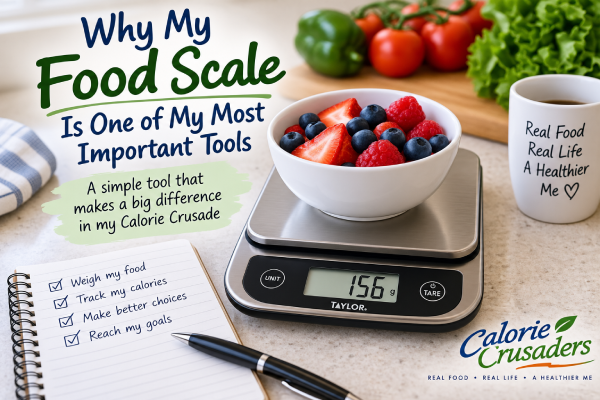
There’s a little digital scale sitting on my kitchen counter.
It isn’t fancy. It doesn’t tell me what to eat. It doesn’t count my calories for me, and it certainly doesn’t care whether I’m on a diet.
But it may be one of the most important tools in my Calorie Crusader toolbox.
It’s my food scale.
How Much Am I Really Eating?
Counting calories sounds pretty simple.
Figure out how many calories are in your food, keep track of them and stay within your calorie budget.
There’s just one little problem.
You have to know how much food you’re eating.
If a serving contains 150 calories, I’m not going to lose weight if I think I’m eating one serving when I’m actually eating a serving and a half most of the time.
That’s where my food scale comes in.
My Eyes Aren’t Measuring Cups
I’ve learned that I’m not particularly good at looking at a pile of food and knowing exactly how much it weighs.
I doubt many people are.
An ounce of this, three ounces of that, 28 grams of something else—those amounts can be surprisingly difficult to judge just by looking at them.
And some foods pack a lot of calories into a fairly small amount.
So instead of guessing, I weigh it.
That little number on the scale takes the guesswork out of the equation.
Grams Make Things Easy
One thing I’ve come to appreciate is weighing food in grams.
Food labels often give serving sizes in grams, and Cronometer lets me enter foods by weight. That makes the food scale and Cronometer a pretty good team.
I can put something on the scale, see exactly how many grams I’m eating and enter that amount.
No guessing whether I had “about” a serving.
I know.
There’s a Button I Really Like
If you’ve never used a digital food scale, there’s one little feature that makes the whole thing remarkably easy.
The tare button.
I can put my bowl or plate on the scale and press tare. The scale goes back to zero.
Then I add my food, and the scale tells me only what the food weighs.
I can even zero it again before adding another ingredient.
It’s a tiny feature, but I use it all the time.
Sometimes the Scale Surprises Me
This may be one of the most useful things about weighing food.
Sometimes I discover that the amount I thought was a serving was considerably more than a serving.
Other times I discover I can have more than I thought.
I like those surprises better.
Either way, I have information I didn’t have before.
And if there’s a recurring theme developing in my Calorie Crusade, it’s that I like information.
Do I Have to Weigh Everything Forever?
I don’t think the point is to become afraid to eat something unless there’s a scale nearby.
There will be restaurant meals. There will be meals at someone else’s house. There will be times when weighing something simply isn’t practical.
Then I’ll make my best estimate and move on.
But at home, when my scale is sitting right there on the counter, why guess when I can know?
The more often I weigh the foods I regularly eat, the better I also become at recognizing what reasonable portions actually look like.
Another Tool in the Toolbox
I’ve already written about Cronometer, which helps me keep track of my calories and nutrients.
I have a glucose meter, which gives me another little window into what’s happening inside my body.
And then there’s my food scale.
It may be the simplest of the three.
Put the food on it. Read the number. Enter the amount.
That’s about it.
But when I’m trying to count calories accurately, knowing how much I’m actually eating makes a tremendous difference.
My food scale doesn’t decide what I can eat.
It just keeps me honest about how much of it I’m eating.
And on this Calorie Crusade, that’s a pretty useful little tool to have sitting on my kitchen counter.
Leave a Reply