Tag: Healthy Habits

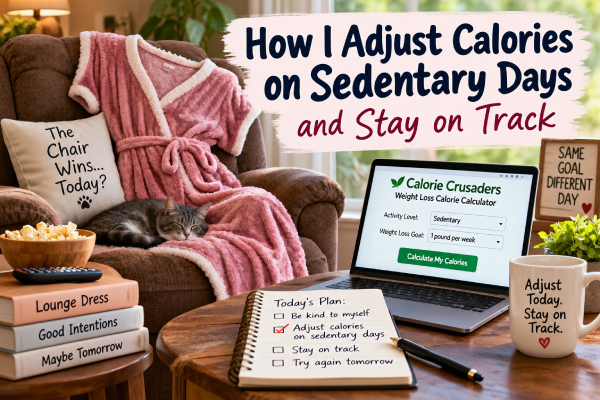
  • How I Adjust Calories on Sedentary Days and Stay on Track

    How I Adjust Calories on Sedentary Days and Stay on Track

    Some days I get plenty of movement. I cook, clean, take care of the chickens, walk around the house, and generally stay busy.

    Then there are other days.

    Those are the days when my chair starts calling my name. My lounge dress gets involved. Before I know it, the two of them are working together against me.

    Some days I just don’t want to move.

    But I’ve discovered something important. I can adjust calories on sedentary days and still stay on track with my weight loss.

    And now I have a weapon to use against that chair.

    Not Every Day Is Going to Be an Active Day

    I’ve been paying much more attention to my activity lately.

    I’ve learned how much of a difference ordinary movement can make. Cooking, cleaning, walking, and doing chores all count.

    But I’ve also learned something else.

    I’m not going to be equally active every day.

    Sometimes I’m tired. Sometimes I don’t feel like doing much. The weather may be bad. I might not feel well. Or I might simply have one of those days when my chair seems unusually comfortable.

    That doesn’t mean my weight-loss plan has to go out the window.

    I Can Change the Calculator Instead

    Our Weight Loss Calorie Calculator lets me choose my activity level.

    So, if I’ve had a sedentary day, I can set the calculator to sedentary.

    Then I can see approximately how many calories I can eat while still working toward my weight-loss goal.

    That’s a big deal for me.

    Before, I tended to think mostly about how many calories I planned to eat each day. Now I’m looking at both sides of the equation.

    How much am I eating, and how active am I?

    If my activity changes, my calorie needs change too.

    A Sedentary Day Doesn’t Mean I Failed

    This may be the most important thing I’ve learned.

    Having a sedentary day doesn’t mean I’ve failed.

    I don’t have to look at the clock late in the afternoon, realize I haven’t done much, and decide the whole day is ruined.

    Instead, I can make an adjustment.

    I can put my information into the calculator, choose sedentary as my activity level, and look at my options.

    Maybe I still want to aim for my usual rate of weight loss. Or maybe I decide that a slightly smaller calorie deficit makes more sense that day.

    Either way, I’m making a conscious decision.

    I’m still in control of my plan.

    My Weight-Loss Plan Can Bend Without Breaking

    I’m beginning to realize that flexibility may be one of the things that helps me stick with this long term.

    I don’t need every day to look exactly the same.

    On an active day, I may have more room in my calorie budget.

    On a sedentary day, I may need less food because I’m burning fewer calories.

    The important thing is that I have a way to adjust.

    That’s much better than expecting myself to be perfectly active every single day.

    The Chair Has Finally Met Its Match

    For quite a while, I’ve joked that my chair and my lounge dress have been conspiring against me.

    I still don’t entirely trust either one of them.

    Some days I win. Some days the chair wins. And some days I suspect my lounge dress is working for the chair.

    But now the balance of power has shifted.

    I have the Weight Loss Calorie Calculator.

    If the chair wins the activity battle for one day, that doesn’t mean it gets to win the whole war.

    I can adjust my calorie intake and keep going.

    And tomorrow?

    Tomorrow I’ll get up and try again.

    Calorie Crusaders Tip

    Don’t use a sedentary day as a reason to give up on your plan. If your activity is lower than usual, recalculate your calorie needs for that activity level. You may find that a small adjustment is all you need to stay on track.

    Calorie estimates are only estimates. Individual calorie needs can vary based on metabolism, body composition, health, medications, and other factors. The Calorie Crusaders calculators are intended for general informational purposes and are not a substitute for medical or nutritional advice.
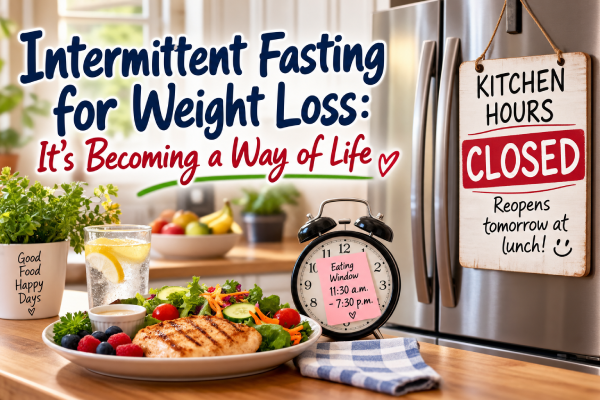

  • Intermittent Fasting for Weight Loss: It’s Becoming a Way of Life

    Intermittent Fasting for Weight Loss: It’s Becoming a Way of Life

    I have found a really good weapon for my Calorie Crusader arsenal.

    When I first started intermittent fasting for weight loss, I wasn’t sure how well it would work for me. I knew the idea was simple. Eat during a certain number of hours each day and fast during the remaining hours. But would I enjoy it? Would I be hungry all the time? Could I actually stick with it?

    As it turns out, I love it!

    In fact, intermittent fasting has become one of my favorite tools for managing my calories. It feels so natural that I can see myself eating this way for the rest of my life.

    My 16/8 Intermittent Fasting Schedule

    I follow what is commonly called the 16/8 method. That means I have an eight-hour eating window followed by a 16-hour fast.

    Most days, I don’t even think about eating until around 11:30 a.m. or noon. Then I close the kitchen around 7:30 or 8:00 p.m.

    And that’s it!

    I don’t spend my mornings watching the clock or wishing I could have breakfast. I’m simply not hungry.

    The surprising thing is how quickly I adjusted. I expected that skipping breakfast might be difficult. Instead, this schedule felt natural almost immediately.

    My Calories Stretch Further

    This is probably my favorite thing about intermittent fasting.

    I have a daily calorie budget. Whether I spread those calories across 12 hours or eight hours, the total is still the same.

    But here’s the difference.

    When I eat during a shorter window, I have fewer hours to divide those calories between. That gives me more room for satisfying meals and even a snack or treat.

    I’m not trying to make my calories disappear. I’m simply making them work better for me.

    And believe me, when you’re trying to lose weight without giving up the foods you love, that makes a difference!

    I’m Not Fighting Hunger

    One of the biggest surprises has been how comfortable I feel during my fasting hours.

    I don’t get hungry during that 16-hour period. I don’t wake up thinking about breakfast. And I don’t feel deprived.

    That doesn’t mean everyone will have the same experience. Some people may find fasting uncomfortable or difficult.

    But for me, it has been remarkably easy.

    I think that’s one reason I enjoy it so much. I’m not spending my days fighting against my appetite.

    Instead, I’ve found a routine that seems to fit the way I naturally want to eat.

    My Kitchen Has Business Hours

    Now, this part makes me laugh.

    I’ve always had a kitchen that was open whenever I wanted something to eat. Morning, afternoon, evening, or late at night, the refrigerator was ready to serve.

    Not anymore!

    These days, my kitchen has business hours.

    Around 8:00 p.m., we’re closed!

    The refrigerator may still be running, but I’m officially off duty.

    And the funny thing is, I don’t mind a bit.

    Once I’ve finished eating for the evening, I don’t feel the need to wander back into the kitchen looking for something else.

    Apparently, even my refrigerator can learn to respect a schedule!

    I’m Flexible When I Need to Be

    I don’t believe a weight-loss plan should make everyday life unnecessarily difficult.

    Some mornings, I have several hours of heavy housecleaning ahead of me. That’s a lot of physical activity, and I may need breakfast before getting started.

    On those days, I eat breakfast.

    I’m not going to ignore my body’s needs just to keep a perfect fasting schedule.

    The next day, I can return to my usual routine.

    To me, that’s part of making this a lifestyle rather than another strict diet.

    Intermittent Fasting Isn’t Magic

    I want to make one thing clear.

    Intermittent fasting doesn’t make calories stop counting.

    I still pay attention to what I eat. I still measure portions and use my calorie calculator. And I still work toward staying within my daily calorie budget.

    For me, the benefit is that intermittent fasting makes those things easier.

    I have fewer hours available for eating, and I’m more satisfied with the meals I enjoy during that time.

    It’s also important to remember that intermittent fasting isn’t right for everyone. Some people need regular meals because of medications or medical conditions. Anyone considering fasting should make sure it’s appropriate for their health.

    I Think I’m Here to Stay

    When I started Calorie Crusaders again, I wanted to find a way to lose weight that I could actually live with.

    I didn’t want to give up all my favorite foods. I didn’t want to be miserable. And I certainly didn’t want another plan that I would abandon after a few weeks.

    Intermittent fasting has turned out to be a wonderful fit for me.

    I enjoy my meals. I feel satisfied. And I don’t spend my fasting hours wishing I could eat.

    Most importantly, I don’t feel like I’m enduring something temporary.

    I feel like I’ve found a way of eating that I can happily continue for years to come.

    And that’s a pretty wonderful feeling.

    So, if you’re looking for me before noon, I’ll probably be enjoying my morning coffee.

    The kitchen doesn’t open until lunchtime!

    Another weapon for my Calorie Crusader arsenal.

    Happy crusading!


    Calorie Crusaders Reminder: This article shares my personal experience, not medical advice. Intermittent fasting affects people differently and may not be appropriate for everyone. Talk with your healthcare professional before starting, especially if you have a medical condition or take medication that may be affected by fasting.

  • Glenn Joins the Calorie Crusade

    Glenn Joins the Calorie Crusade

    Well, apparently the Calorie Crusade is contagious. Glenn has joined me, and now we’re losing weight together.

    I mentioned in my article about Cronometer that Glenn had started using it too. That was worth a sentence then, but I think it deserves a little more attention now.

    I’m no longer the only Calorie Crusader in this house.

    It Started With Cronometer

    I’ve been using Cronometer to keep track of my calories and nutrition, and Glenn decided to give it a try too.

    Now we’re both entering our food and keeping track of what we’re eating.

    I think that’s going to be a good thing.

    When only one person in a household is trying to pay attention to food, it can sometimes feel like you’re doing your own separate little project.

    Now we’re doing it together.

    We’re Still Two Different People

    That doesn’t mean Glenn and I need to eat exactly the same amount or have exactly the same goals.

    We don’t.

    We’re two different people.

    But we can still support each other while each of us follows the plan that works for us.

    We can eat many of the same meals. We can talk about what we’re learning. We can compare notes about Cronometer. And when one of us discovers something useful, we can share it with the other.

    That makes the whole process a little more interesting.

    It Makes Cooking Easier Too

    There’s another practical advantage to having both of us paying attention.

    We live in the same house and eat a lot of the same food!

    When I make one of our regular recipes, I can enter it into Cronometer and figure out the calories and nutrients per serving.

    Then we’re both working from the same information.

    I’m already paying more attention to portions and what’s actually going into our meals. Now that information can be useful to both of us.

    I’m Not Going to Be the Food Police

    There is one thing I don’t want this to become.

    I don’t want to spend my days watching what Glenn eats, and I’m pretty sure he doesn’t want to spend his days watching what I eat.

    We’re adults.

    We’re each responsible for our own choices.

    If Glenn wants something, that’s his decision. If I want something, that’s mine.

    Supporting each other doesn’t mean policing each other.

    I’d much rather have someone beside me saying, “Okay, let’s keep going.”

    Two Calorie Crusaders

    I’m glad Glenn decided to join me.

    Losing weight and changing habits are still things each of us has to do for ourselves. Nobody else can make those choices for us.

    But that doesn’t mean we have to do everything alone.

    We can encourage each other.

    We can laugh about the occasional ridiculous serving size.

    We can share recipes.

    We can celebrate the good weeks.

    And when one of us has a not-so-good week, maybe the other one can help remind us that one week isn’t the whole journey.

    When I brought Calorie Crusaders back, I thought I was restarting my own journey.

    It looks like I’ve picked up another crusader along the way.

    Welcome aboard, Glenn.

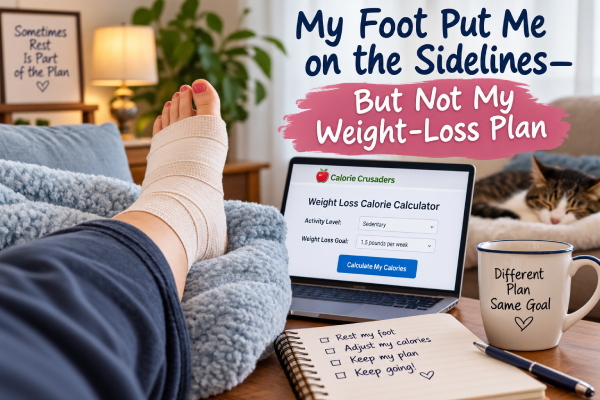
  • My Foot Put Me on the Sidelines—but Not My Weight-Loss Plan

    My Foot Put Me on the Sidelines—but Not My Weight-Loss Plan

    Sometimes life has a way of changing your plans.

    This time, it was my foot.

    Weight loss while injured is something I hadn’t really thought much about until now. I’ve hurt my foot, and for the next couple of days I need to stay off of it as much as possible. That means my normal daily activity is going to drop considerably.

    And that presented me with a question.

    What happens to my weight-loss plan when I suddenly can’t be as active?

    Weight Loss While Injured

    I’m currently trying to lose about 1½ pounds per week. Normally, my activity around the house helps determine how many calories I can eat while still working toward that goal.

    But sitting with my foot up is definitely not my normal activity level!

    For the next few days, I may be much closer to sedentary.

    That’s where our Weight Loss Calorie Calculator became especially useful.

    Instead of guessing what I should do, I can change my activity level to sedentary and let the calculator give me a new calorie target.

    I Can Look at My Options

    One thing I really like about the calculator is that I don’t have to make this an all-or-nothing decision.

    I can set my activity level to sedentary and see approximately how many calories I would need to eat to continue losing 1½ pounds per week.

    Then I can change my goal to 1 pound per week and see that calorie target, too.

    That gives me a choice.

    Maybe I decide that I still want to aim for 1½ pounds per week.

    Or maybe I decide that while my foot is healing, one pound per week is a more reasonable goal.

    Either way, I have information I can use to make that decision.

    My Plan Changed. My Goal Didn’t.

    This is one of those situations that could easily throw me off track.

    I could think, “Well, I can’t do my normal activity, so there goes this week’s weight loss.”

    But that’s not necessarily true.

    My activity level changed. That simply means I may need to adjust my calorie target for a few days.

    That’s very different from giving up.

    And I’m certainly not going to keep walking around on a sore foot just so my activity calculator will be happy with me. 😂

    Right now, resting my foot is more important.

    Sometimes Rest Is Part of the Plan

    There is another side to this that I think is important.

    Getting injured isn’t a reason to drastically cut calories. Our bodies still need good nutrition, especially when they’re recovering.

    So I’m not looking at this calculator and asking, “How little can I eat?”

    I’m asking, “What is a reasonable calorie goal for my current activity level?”

    That’s a much better question.

    For me, the answer may even be to temporarily slow my expected rate of weight loss.

    A few days at a different calorie target aren’t going to ruin everything I’ve been working toward.

    This Is Why I Like Having Tools

    When we created the Weight Loss Calorie Calculator, we thought of it mainly as a way to determine a calorie goal based on weight, activity and desired rate of weight loss.

    Now I’m finding another use for it.

    Life changes.

    Our activity changes.

    Sometimes we’re busy and moving all day. Other times, a sore foot puts us in a chair whether we like it or not.

    Having a tool that lets me change those numbers helps me adjust my plan instead of abandoning it.

    That’s really what this journey is about.

    I don’t need a perfect week. I just need a plan that can change when life does.

    And for the next couple of days, apparently my plan includes putting my foot up.

    I suppose my chair won this round. 😂

  • I Increased My Activity for Weight Loss — Here Are My Results

    I Increased My Activity for Weight Loss — Here Are My Results

    Last week, I decided to increase my activity for weight loss and see what happened.

    The week before, I had been much too sedentary. I was still watching my calories, but I wasn’t moving enough. At the end of that week, I had lost only 0.6 pound.

    That wasn’t terrible. A loss is still a loss. But I thought I could do better.

    So I decided to run a little one-week experiment.

    My Goal for the Week

    I wasn’t trying to turn myself into an exercise fanatic overnight. I simply wanted to move more during my normal day.

    My goal was to be lightly active instead of sedentary whenever I could.

    I used our Weight Loss Calorie Calculator to see how my activity level affected the number of calories I could eat while still working toward my weight-loss goal.

    According to the calculator, I should lose about 1.5 pounds.

    Now I had a number to test.

    I Didn’t Need a Gym to Move More

    One thing I’ve been learning is that physical activity doesn’t have to mean a formal workout.

    There are plenty of opportunities to move during an ordinary day.

    Cooking gets me on my feet. Housework gets me moving. Taking care of the chickens counts. Walking counts. Even those little trips around the house add up.

    That is why we created the Everyday Activity Burn Calculator.

    You can choose different ordinary activities and see an estimate of how many calories you may burn doing them.

    That calculator helped me look at everyday movement differently.

    Instead of thinking, I need to exercise, I could think, I need to move.

    For me, that’s a lot easier.

    What I Actually Did

    I didn’t manage to be lightly active every single day.

    For five days, I was lightly active.

    For two days, I was sedentary.

    That’s real life.

    Some days I move more than others. The important thing was that I had increased my activity quite a bit compared with the previous week.

    Then came weigh-in day.

    The Results Are In

    I lost 1.6 pounds!

    The calculator had predicted approximately 1.5 pounds.

    That’s only one-tenth of a pound difference between the calculator’s estimate and what actually showed up on my scale.

    I was very pleased with that.

    I was even happier when I compared it with the previous week.

    When I was too sedentary, I lost 0.6 pound.

    After increasing my activity, I lost 1.6 pounds.

    That’s a full pound more on the scale this week.

    Did the Extra Activity Cause the Difference?

    I can’t say that every bit of that difference came from being more active.

    Body weight naturally fluctuates. Water, digestion and other factors can affect the number on the scale from one week to the next.

    That’s one reason I don’t want to judge my progress by a single weigh-in.

    Still, this experiment gave me exactly the kind of result I was hoping to see.

    I ate according to my calorie goal. I increased my everyday activity. The calculator predicted a loss of about 1.5 pounds.

    And I lost 1.6.

    I’ll take it!

    Everyday Movement Really Does Matter

    The biggest lesson I learned this week is that I don’t have to spend hours exercising to become more active.

    I can look for opportunities to move throughout my day.

    I can cook. I can clean. I can walk. I can take care of the animals. I can get up and do something instead of spending quite so much time sitting.

    Those ordinary activities may not feel like exercise.

    But they’re still movement.

    And movement adds up.

    For me, this experiment wasn’t about becoming an athlete.

    It was about getting out of that chair a little more often.

    Apparently, my chair and I needed some time apart anyway. 😂

    One week doesn’t prove anything by itself, so I’m going to keep watching my results. But after losing 0.6 pound during my more sedentary week and 1.6 pounds during my more active week, I’m certainly motivated to keep moving.

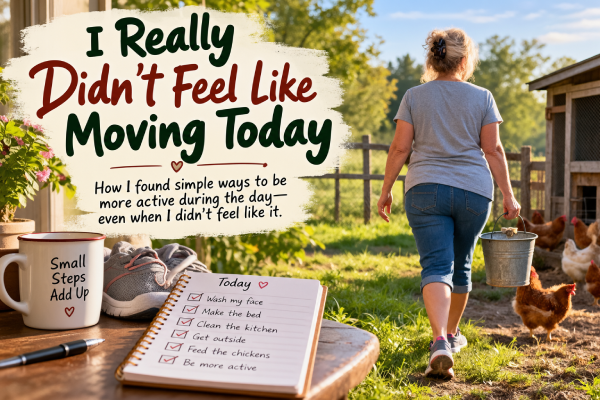
  • I Really Didn’t Feel Like Moving Today

    I Really Didn’t Feel Like Moving Today

    This morning, I was really out of snuff.

    I knew I needed to figure out how to be more active during the day. There was just one problem.

    I really, really didn’t feel like doing it.

    I’ve been down in my back lately, and somewhere along the way I got out of the habit of getting things done. On days when we don’t have work, I’ve even gotten into the habit of staying in my lounge dress all day.

    This morning, I needed to figure out how to get myself moving again.

    I Started by Journaling

    I tried journaling first.

    That helped a little. Writing things down gave me a chance to think about what was bothering me and what I wanted to accomplish.

    But I still needed something more practical.

    So I made myself a list.

    It wasn’t a list of exercises. It was a list of ordinary daily tasks that would get me up and moving.

    Some of them were very simple.

    Wash my face.

    Make the bed.

    Clean the kitchen.

    These aren’t things I would normally think of as exercise. But they do require me to get out of my chair and move.

    And that was exactly what I needed.

    Then I Got Dressed

    This may sound like a little thing, but I think it made a big difference.

    I got dressed.

    Not in my lounge dress. I put on regular clothes and my shoes.

    That seemed to tell my brain that the day had started and I had things to do.

    Apparently, my lounge dress may have been conspiring with my chair. I’m keeping an eye on both of them.

    I Put My Day on the Calendar

    I use Google Calendar to help keep myself organized, so I put my tasks there.

    I also set those tasks to repeat every day.

    Now I don’t have to start from scratch each morning and figure out how I’m going to get moving.

    I already have a simple daily activity plan waiting for me in my calendar.

    That gave me something else I needed.

    I could mark things complete.

    There is something satisfying about finishing a task and checking it off. Then I could move on to the next one.

    Instead of looking at the whole day and thinking about everything I needed to accomplish, I could concentrate on one little thing at a time.

    And every little thing got me moving.

    I Watched My Activity Add Up

    I also used the cardio load feature on my Google Health watch.

    I have a weekly cardio goal, and I could see my activity adding up as I went through my day.

    That gave me another little push to keep going.

    I wasn’t doing a formal workout. I was simply trying to have an active day.

    And it was working.

    Even Feeding the Chickens Became Exercise

    Normally, I might take the golf cart out to feed the chickens.

    Today I walked.

    It was a small decision, but that’s really what the whole day was about.

    Small decisions.

    Get dressed instead of staying in my lounge dress.

    Put on my shoes.

    Make the bed.

    Clean the kitchen.

    Walk instead of taking the golf cart.

    One choice didn’t amount to very much. But by the end of the day, all those choices had added up to a good amount of light activity.

    I Didn’t Wait Until I Felt Like It

    I think that’s the biggest thing I learned today.

    This morning, I didn’t feel motivated.

    I could have waited around hoping motivation would eventually show up.

    Instead, I started doing little things.

    And somewhere along the way, my attitude changed.

    I felt more focused. I felt more productive. And I ended up having a very good day.

    Maybe I don’t always have to feel motivated before I start.

    Maybe sometimes I just need to put on my shoes and do the first thing on the list.

    Then I can see where the day takes me.

    Today, it took me all the way out to the chicken coop.

    On foot.

  • Exercise: It’s All About Movement

    Exercise: It’s All About Movement

    When I think about exercise for weight loss, I’m beginning to realize that it doesn’t always have to mean putting on workout clothes and doing an exercise routine. Sometimes I simply need to get up and move.

    I learned that lesson after having what I thought was a really good week.

    I counted my calories. I stayed on track. I felt pretty good about how I had done.

    There was just one problem.

    I had also been very sedentary.

    That Wasn’t the Number I Was Hoping For

    When I stepped on the scale at the end of the week, my weight loss was disappointing.

    I knew I had done well with my calories, so naturally I started thinking about what else had been different that week.

    And one thing stood out.

    I hadn’t moved very much.

    I had spent far too much time sitting.

    Now, one week’s number on the scale doesn’t prove anything. Weight can fluctuate for all kinds of reasons.

    But it did make me curious.

    Then I Looked at the Calculator

    I started looking more closely at how many calories I should be eating to lose weight.

    That’s when I used our Weight Loss Calorie Calculator.

    What caught my attention was the difference activity makes.

    When I selected sedentary, I could see that my estimated calorie needs weren’t nearly as high as they would be if I were more active.

    That gave me something to think about.

    I realized that counting my calories was only part of what I wanted to work on.

    I needed to move more too.

    Exercise Doesn’t Have to Mean a Workout

    When I hear the word exercise, it’s easy to picture an exercise routine.

    But movement doesn’t have to happen only during a workout.

    I can walk.

    I can clean the house.

    I can work outside.

    I can get up and do something instead of sitting in my chair.

    Of course, I can deliberately exercise too.

    The important thing for me is to move.

    So I’m Putting More Movement Into My Day

    This week, I’m making a point of being more active every day.

    I haven’t suddenly become an athlete.

    I’m just paying attention.

    If I have an opportunity to move, I’m trying to take it.

    Instead of thinking that exercise has to be a separate event that I somehow have to fit into my day, I’m thinking about how I can put more movement into my day.

    That feels much more manageable to me.

    So What Will the Scale Say?

    I don’t know yet.

    That’s the interesting part.

    I’m counting my calories, and this week I’m deliberately adding more movement to my days.

    Will I have a better weight loss when I step on the scale next week?

    Maybe.

    Maybe not.

    Weight can fluctuate for plenty of reasons, so one week won’t prove anything either way.

    But I’m curious.

    And since you’re following along on my Calorie Crusade, you’ll find out when I do.

    To be continued…