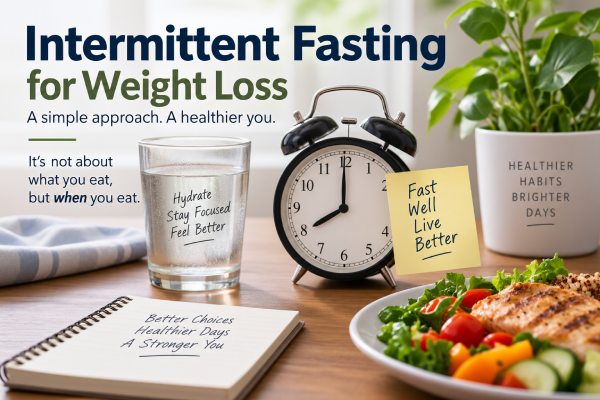
I sometimes find myself doing a little intermittent fasting without really planning to.
If I eat supper in the evening and don’t eat again until later the next morning, I’ve gone quite a few hours without eating. That got me interested in intermittent fasting and whether it can actually be useful when you’re trying to lose weight.
Intermittent fasting isn’t really a diet in the traditional sense. It doesn’t tell you what foods you can or can’t eat. Instead, it is an eating pattern that limits when you eat.
For some people, that can be a useful way to control calories.
What Is Intermittent Fasting?
Intermittent fasting simply means alternating periods of eating with periods when you don’t eat.
There are several ways people do it.
12:12 fasting means fasting for 12 hours and having a 12-hour eating window. Someone who finishes supper at 7 p.m. and eats breakfast at 7 a.m. is already doing this.
14:10 fasting allows eating during a 10-hour period followed by a 14-hour fast.
16:8 fasting is probably one of the best-known versions. You fast for 16 hours and eat during an eight-hour window.
There are also more restrictive approaches, including alternate-day fasting and the 5:2 method, where calorie intake is greatly reduced on two days of the week.
For someone who is mainly interested in controlling calories, however, intermittent fasting doesn’t have to be complicated.
Can Intermittent Fasting Help With Weight Loss?
It can.
Research has found that intermittent fasting can result in weight loss, but it doesn’t appear to have a huge advantage over ordinary calorie restriction.
That makes sense.
If shortening the number of hours you eat during the day causes you to eat fewer calories overall, you may lose weight. But an eight-hour eating window doesn’t give you permission to eat unlimited calories during those eight hours.
Calories still count.
A 2026 Cochrane review found that intermittent fasting generally produced little to no additional weight-loss benefit compared with conventional dietary advice. Other research has similarly found that intermittent fasting and continuous calorie restriction can produce comparable reductions in body weight.
So intermittent fasting may be better thought of as a tool for controlling calorie intake rather than a shortcut around it.
Why Might It Make Calorie Control Easier?
This is the part that interests me.
If you’re not eating during certain hours, you’re eliminating opportunities to eat.
Someone who stops eating after supper, for example, may eliminate an entire evening of snacking without having to count or resist each individual snack.
The same thing can happen in the morning. If you’re comfortable eating your first meal somewhat later, you may naturally end up eating fewer calories during the day.
That doesn’t work for everybody. Some people become so hungry during a fast that they make up for those calories later.
The important question is whether the eating pattern makes calorie control easier for you.
What Can You Have During a Fast?
A true fasting period generally means consuming no calories.
Water is the simplest choice.
Plain coffee and unsweetened tea are also commonly used during fasting periods because they contain very few calories.
Once you start adding sugar, cream, milk or other calorie-containing ingredients, you’re no longer technically fasting.
But remember why you’re doing it.
If your primary goal is weight loss and a little milk in your morning coffee helps you stick with an eating pattern that keeps your total calories under control, that may matter more to you than following a perfect definition of fasting.
You Still Need Good Nutrition
Eating during fewer hours doesn’t mean nutrition becomes less important.
In fact, it can make planning nutritious meals even more important because you have fewer opportunities during the day to get the protein, fiber, vitamins and minerals your body needs.
Protein deserves particular attention as we get older because maintaining muscle becomes increasingly important.
Strength exercise, adequate protein and a nutritious diet remain important whether you practice intermittent fasting or eat throughout the day.
What About Intermittent Fasting After 60?
This is an area where researchers are still learning.
Most of the earlier intermittent-fasting research involved younger or middle-aged adults. Newer research involving adults over 60 suggests that some forms of intermittent fasting can produce modest weight loss, but we still don’t have enough long-term evidence to know exactly which fasting schedules are best for older adults.
Maintaining muscle and getting adequate nutrition are especially important as we age.
That is one reason I don’t think intermittent fasting needs to become a contest to see how long you can go without eating.
A relatively modest overnight fast may be quite different from regularly going extremely long periods without food.
Intermittent Fasting Isn’t for Everyone
Some people should be particularly cautious about fasting.
People taking medications that can be affected by food intake, people with diabetes who use certain glucose-lowering medications, people with a history of eating disorders, and people with medical conditions that affect their nutritional or fluid needs should discuss fasting with their healthcare provider.
Older adults should also pay attention to whether fasting makes it difficult to consume enough protein, calories or other nutrients.
And if you have kidney disease or another chronic medical condition, it’s worth talking with your doctor before intentionally adopting a restrictive fasting schedule.
A Tool, Not a Rule
I think this may be the most useful way to look at intermittent fasting.
You don’t necessarily have to announce, “I’m intermittent fasting,” buy anything special or follow an exact schedule.
Maybe you simply decide the kitchen is closed after supper.
Maybe you’re not hungry first thing in the morning, so you wait awhile before breakfast.
If doing that comfortably eliminates some calories you would otherwise have eaten, intermittent fasting may be one more useful tool in your weight-loss toolbox.
But it isn’t magic.
Ultimately, weight loss still comes down largely to consuming less energy than your body uses over time.
The best eating pattern is one that helps you do that while still getting the nutrition you need — and one you can actually live with.