
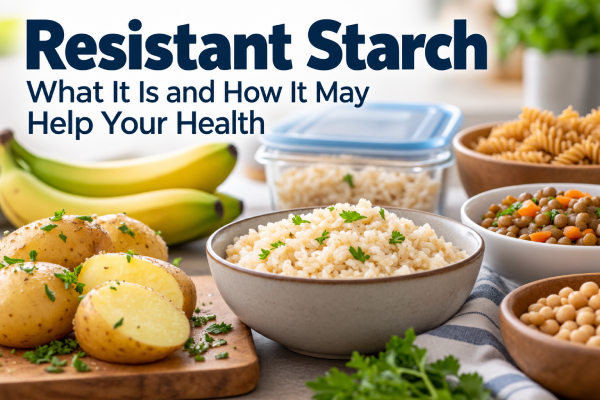
You may have heard that cooking and cooling foods like rice or potatoes can change the starch in them. It sounds a little strange, but there is some real science behind it.
The result is called resistant starch.
Resistant starch is a type of starch that resists digestion in the small intestine. Instead of being completely broken down into glucose, some of it travels on to the large intestine. There, bacteria can ferment it. In that way, resistant starch behaves somewhat like dietary fiber.
That doesn’t mean a bowl of cold rice suddenly becomes a low-calorie food. And, unfortunately, cooling a potato does not turn it into celery. If it did, I would have discovered the easiest diet in history.
But resistant starch is interesting, and there may be some good reasons to include foods that contain it in a balanced diet.
What Is Resistant Starch?
Most starch is broken down during digestion into glucose. Your body can then use that glucose for energy.
Resistant starch is different. Some of it escapes digestion in the small intestine and reaches the large intestine. There, it can be fermented by bacteria in the gut.
This fermentation produces compounds called short-chain fatty acids. One of these is butyrate, which is an important fuel source for cells lining the colon.
Researchers are continuing to study how resistant starch affects the gut microbiome and overall health.
Where Does Resistant Starch Come From?
Resistant starch occurs naturally in a variety of foods.
Sources can include:
- Beans and lentils
- Whole or less-processed grains
- Rice
- Pasta
- Potatoes
- Bananas and plantains, particularly when less ripe
- Some breads and cereals
The amount of resistant starch in a food can vary quite a bit. The variety of the food, how it is processed and how it is cooked can all make a difference.
Cooking and Cooling Can Change Starch
This is where resistant starch gets especially interesting.
When certain starchy foods are cooked, their starch becomes easier to digest. But when some of those foods are cooled after cooking, part of the starch can reorganize into a structure that is harder for our digestive enzymes to break down.
This process is called retrogradation.
The resistant starch created through cooking and cooling is generally known as Type 3 resistant starch.
Studies have found that cooked foods that are later chilled can contain more resistant starch than the same foods when freshly cooked.
What About Leftover Rice?
Rice is a good example.
Research has found that cooking rice, cooling it and then reheating it can increase its resistant starch compared with freshly cooked rice.
Some studies have also found a lower rise in blood glucose after eating cooled and reheated rice.
That doesn’t mean reheated rice suddenly contains no digestible carbohydrate. Most of the carbohydrate is still there.
It simply means that the way our bodies digest some of the starch may have changed.
There is also an important food-safety issue with rice. Cooked rice should be refrigerated promptly and stored safely. Cooling rice on the counter for long periods just to create resistant starch is not a good idea.
What About Potatoes?
Potatoes can also develop more resistant starch after they are cooked and cooled.
You might use cooled potatoes in potato salad, for example.
Reheating is a little more complicated. The amount of resistant starch that remains can depend on the food and the way it was prepared, cooled and reheated.
So I wouldn’t worry about trying to create the “perfect” resistant-starch potato.
If you enjoy leftover potatoes cold, that’s fine. If you prefer them reheated, that’s fine too.
Remember, we’re looking for useful eating habits, not conducting a chemistry experiment every time we make supper.
Can Resistant Starch Help With Blood Sugar?
This is one of the most interesting areas of resistant starch research.
Because resistant starch isn’t digested in exactly the same way as regular starch, meals containing more resistant starch may produce a different blood-glucose response.
Studies involving cooled rice, for example, have found lower post-meal glucose responses under certain conditions.
However, results can vary by food and by person. Resistant starch should not be considered a treatment for diabetes or a replacement for medical care.
If you use insulin or medication that can cause low blood sugar, changes that significantly affect the carbohydrate you absorb may also affect your glucose response.
Resistant Starch and Gut Health
Resistant starch also feeds bacteria in the large intestine.
As those bacteria ferment resistant starch, they produce short-chain fatty acids, including butyrate.
This is one reason resistant starch is being studied for its possible role in supporting a healthy gut environment.
The response isn’t identical for everyone. Different people have different gut microbiomes, so the effects of resistant starch can vary.
Does Resistant Starch Help With Weight Loss?
Here’s where we need to keep things in perspective.
Resistant starch is interesting, but it isn’t a weight-loss shortcut.
Research is still being done on resistant starch, appetite, fullness, insulin sensitivity and body weight. Some findings are promising, but that doesn’t mean eating cold potatoes will make the pounds fall off.
For weight loss, total calorie intake still matters.
A cup of rice does not become a free food because you put it in the refrigerator overnight.
I know. I was disappointed too.
Does Cooling Food Remove Calories?
No.
This is an important distinction.
Cooling a starchy food may cause some of its starch to become more resistant to digestion. It does not remove all the calories from the food.
The amount of resistant starch created can also vary considerably.
For Calorie Crusaders, I think the best approach is to continue counting the normal calories for the food.
If I eat a serving of rice that has been cooked, cooled and reheated, I’m still going to log that serving of rice normally.
Any resistant starch is simply a possible nutritional bonus.
An Easy Way to Use This Information
You don’t have to buy special resistant-starch products or completely change the way you eat.
Sometimes it can be as simple as making a batch of rice ahead of time, refrigerating it and using it with tomorrow’s meal.
The same idea can work with potatoes or pasta.
Beans and lentils are another easy choice because they naturally provide resistant starch along with other nutrients and fiber.
Just remember that resistant starch is one part of the bigger picture.
Calorie Crusaders Tip
If you’re already meal prepping, resistant starch may be one more reason to prepare some starchy foods ahead of time.
For example, I can make rice the day before I need it, refrigerate it and reheat it for supper the next day. It saves me some work at mealtime, and the cooling process may increase the amount of resistant starch.
That’s my kind of nutrition strategy.
Less work tomorrow and a possible nutritional benefit today.
And no, the potato still hasn’t turned into celery.
This information is for general educational purposes only and is not medical or nutritional advice. Individual nutritional needs and blood-glucose responses can vary. If you have diabetes, take glucose-lowering medication, or have a medical condition that affects your diet, talk with your healthcare professional about dietary changes.