
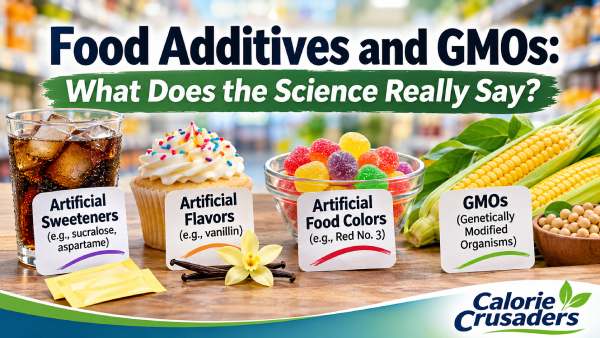
When we shop for groceries, we encounter many ingredients that may be unfamiliar.
Artificial sweeteners, flavors, and food colors appear in everything from beverages to baked goods. We may also see foods labeled as bioengineered or non-GMO.
What do these terms mean? How are these ingredients evaluated for safety? And what should we consider when choosing foods for ourselves and our families?
Understanding the science can help us make informed decisions.
Why Are Additives Used in Food?
Food manufacturers use additives for several reasons.
Some improve flavor or appearance. Others help preserve freshness, maintain texture, or prevent spoilage.
For example, preservatives can slow food spoilage. Emulsifiers help ingredients stay mixed. Sweeteners provide sweetness with or without additional calories.
The U.S. Food and Drug Administration (FDA) evaluates and regulates food additives to help ensure their safety under intended conditions of use.
Not every ingredient follows the same regulatory process. Some substances are classified as Generally Recognized as Safe (GRAS) for specific uses.
The safety of an ingredient depends on several factors. These include its chemical properties, the amount consumed, and how frequently exposure occurs.
Artificial Sweeteners: Understanding the Research
Artificial sweeteners provide sweetness with few or no calories.
Common examples include:
- Sucralose: Sold under the brand name Splenda.
- Aspartame: Found in Equal and NutraSweet.
- Saccharin: Found in Sweet’N Low.
- Acesulfame potassium: Often called Ace-K.
These sweeteners are much sweeter than ordinary table sugar. Therefore, relatively small amounts can provide substantial sweetness.
Are Artificial Sweeteners Safe?
The FDA has reviewed scientific research on approved artificial sweeteners.
Based on available evidence, the agency considers these sweeteners safe under their approved conditions of use.
For several sweeteners, scientists have established an acceptable daily intake.
What Is an Acceptable Daily Intake (ADI)?
An acceptable daily intake (ADI) is the amount of a substance considered safe to consume every day over a lifetime.
Scientists establish ADIs using toxicological research and safety factors.
The ADI is not the amount at which a substance suddenly becomes harmful. Instead, it represents a conservative exposure level intended to protect consumers.
The FDA has established the following limits:
| Sweetener | FDA Acceptable Daily Intake |
|---|---|
| Sucralose (Splenda) | 5 mg per kilogram of body weight daily |
| Aspartame (Equal) | 50 mg per kilogram of body weight daily |
These limits are based on the weight of the sweetener itself, not the total weight of a packet or beverage.
For example, consider an adult weighing 132 pounds, or approximately 60 kilograms.
That person’s daily ADI would be:
- Sucralose: 300 milligrams.
- Aspartame: 3,000 milligrams.
To make these figures easier to understand, the FDA provides estimates based on individual sweetener packets.
According to its calculations, a 132-pound adult would reach the ADI at approximately 23 sweetness-equivalent packets of sucralose or 75 packets of aspartame.
Actual amounts depend on the sweetener content of each product.
Readers can explore these limits in the FDA’s explanation of aspartame and other sweeteners.
How Much Aspartame Is in a Diet Soda?
Diet soda provides a practical example of how sweetener consumption can be evaluated.
A typical 12-ounce diet soda sweetened with aspartame may contain approximately 180–200 milligrams of the sweetener. However, amounts vary by product and formulation.
Using 200 milligrams as an example, one can would provide approximately 7% of the FDA’s daily ADI for a 132-pound adult.
Some diet sodas use more than one sweetener. A beverage might contain aspartame, acesulfame potassium, sucralose, or a combination.
The ingredient list tells us which sweeteners are present. However, it generally does not tell us exactly how many milligrams of each sweetener the beverage contains.
That makes it difficult to calculate an exact percentage of the ADI without additional information from the manufacturer.
The FDA’s guide to food ingredients explains how ingredients are identified on food labels.
Do Artificial Sweeteners Help With Weight Loss?
Replacing sugar with a low-calorie sweetener can reduce the calories in a particular food or beverage.
However, reducing calories in one product does not automatically produce long-term weight loss.
Overall eating habits still matter.
In 2023, the World Health Organization (WHO) issued a conditional recommendation against using non-sugar sweeteners as a strategy for long-term weight control.
The organization found that available research did not establish lasting benefits for reducing body fat. It also identified possible associations with certain health conditions.
However, some findings came from observational studies. These studies cannot always establish whether sweeteners caused the reported outcomes.
Importantly, the WHO guideline did not replace established toxicological safety limits for individual sweeteners.
The recommendation also does not apply to people with pre-existing diabetes.
You can read the WHO guideline on non-sugar sweeteners for more information.
For people counting calories, artificial sweeteners may be one way to reduce added sugar. They are not necessary for successful weight management.
People with phenylketonuria (PKU) must avoid or restrict aspartame because it contains phenylalanine.
Artificial Flavors: What Are They?
Flavoring ingredients help create or enhance the taste and aroma of foods.
Food labels may identify flavors as natural or artificial.
Natural flavors are derived from specified natural sources. These can include fruits, vegetables, spices, and certain animal products.
Artificial flavors contain flavoring substances that do not meet the regulatory definition of natural flavor.
Interestingly, natural and artificial flavors can sometimes contain the same chemical compounds.
Vanillin provides a familiar example.
Vanillin is one of the primary compounds responsible for vanilla’s characteristic flavor. It can be obtained from vanilla beans or produced through other methods.
The source may differ even when the flavoring molecule is the same.
Are Artificial Flavors Harmful?
Flavoring ingredients must meet applicable food safety requirements.
Scientists consider their chemical properties, intended uses, and estimated exposure.
However, flavorings are not all identical. Each substance may have a different safety profile.
Some individuals may also have sensitivities or allergies to particular ingredients.
The FDA explains that food ingredients must meet the same safety standard regardless of whether they come from natural or artificial sources.
Therefore, the words natural and artificial do not independently establish whether a flavoring ingredient is safe or nutritious.
Artificial Food Colors: Why Are They Used?
Food colors improve or maintain the appearance of foods.
They may restore color lost during processing or storage. They can also help create a consistent appearance.
Synthetic colors appear in products such as candies, beverages, cereals, and baked goods.
In the United States, the FDA regulates color additives. Certain synthetic colors also require batch certification.
What Does Research Say About Food Colors?
Researchers have investigated whether some synthetic food colors affect children’s behavior.
Studies have examined possible relationships between color additives and symptoms such as hyperactivity.
The findings have not been entirely consistent.
According to the FDA, most children do not experience adverse behavioral effects from approved food colors. However, some evidence suggests that certain children may be sensitive to them.
Additional research is needed to better understand these possible effects.
The FDA’s consumer information about color additives explains the research and regulatory process.
An Example: Red Dye No. 3
Red Dye No. 3 provides an example of how scientific evidence and regulatory requirements can affect food ingredients.
In January 2025, the FDA announced that it was revoking authorization for FD&C Red No. 3 in foods and ingested drugs.
The decision followed research showing that high doses caused cancer in male laboratory rats.
According to the FDA, the effect involved a hormonal mechanism specific to male rats. The available evidence did not establish that Red No. 3 causes cancer in humans.
Nevertheless, federal law requires the FDA to revoke authorization for certain additives when they have been shown to cause cancer in humans or animals.
Food manufacturers have until January 15, 2027, to reformulate affected products.
The FDA has also encouraged manufacturers to phase out certain other synthetic food colors.
Readers can review the agency’s information about FD&C Red No. 3.
This example demonstrates why food additives should be evaluated individually. It also shows that regulatory decisions can change as scientific evidence and legal requirements are applied.
GMOs: What Does Genetic Modification Mean?
GMO stands for genetically modified organism.
In food production, the term commonly refers to crops developed using genetic engineering.
Scientists use these techniques to introduce or modify specific genetic traits.
For example, certain crops have been developed to resist insect damage or tolerate particular herbicides.
Other modifications may improve nutritional characteristics or reduce food waste.
Genetic engineering differs from traditional plant breeding, although both can change the characteristics of crops.
In the United States, some foods produced through genetic engineering carry a bioengineered food disclosure.
Are GMO Foods Safe to Eat?
According to the FDA, foods produced from genetically engineered plants must meet the same food safety standards as conventionally produced foods.
The agency reports that genetically engineered plant foods evaluated through its consultation process have not shown greater risks of toxicity or allergic reactions than comparable conventional foods.
However, individual products and their characteristics still require appropriate safety evaluation.
Scientists may examine whether genetic changes affect nutritional composition, introduce potential allergens, or create other safety concerns.
The FDA’s guide to understanding new plant varieties explains how these foods are evaluated.
What About Environmental Concerns?
Questions about genetically engineered crops are not limited to human nutrition.
Agricultural practices, pesticide use, pest resistance, and environmental effects are also subjects of research and regulation.
These are important considerations. However, they are different from determining whether a particular food is safe to eat.
The FDA, USDA, and Environmental Protection Agency have different responsibilities in regulating agricultural biotechnology.
The FDA’s explanation of GMO regulation in the United States describes these responsibilities.
Natural and Artificial: Does the Difference Matter?
The words natural and artificial often influence our food choices.
However, neither term provides a complete picture of an ingredient’s safety or nutritional value.
Some naturally occurring substances can be harmful. Many manufactured ingredients can be used safely within established limits.
The most useful questions concern the specific ingredient, its purpose, the amount consumed, and the available scientific evidence.
A food’s overall nutritional value also matters.
For example, a product made with natural ingredients can still contain large amounts of added sugar, saturated fat, or sodium.
Likewise, a product containing an approved additive may provide useful nutrients.
Evaluating the complete food is often more helpful than judging it by one ingredient.
How to Make Informed Food Choices
When choosing foods, consider these practical steps:
- Read the Nutrition Facts label. Look at calories, serving sizes, added sugars, sodium, saturated fat, fiber, and protein.
- Review the ingredient list. Identify ingredients you want to learn more about or avoid for personal reasons.
- Use reliable sources. Government health agencies, scientific organizations, and peer-reviewed research can provide useful information.
- Consider your individual needs. Allergies, medical conditions, and personal sensitivities may influence which foods are appropriate.
- Look at your overall eating pattern. A balanced diet involves more than the presence or absence of a single ingredient.
The Bottom Line
Food additives and genetic engineering are complex subjects.
Different ingredients serve different purposes. Their safety must be evaluated using appropriate scientific evidence.
Some have extensive safety records under established conditions of use. Others have prompted additional research, restrictions, or regulatory changes.
Understanding these differences can help consumers make informed choices.
At Calorie Crusaders, our goal is to provide practical information that supports healthier eating habits.
We believe that learning how foods are made, labeled, and evaluated is an important part of that process.
The more we understand about our food, the better prepared we are to make choices that fit our nutritional needs and personal preferences.
Disclaimer: This article provides general educational information. It is not a substitute for individualized medical or dietary advice.