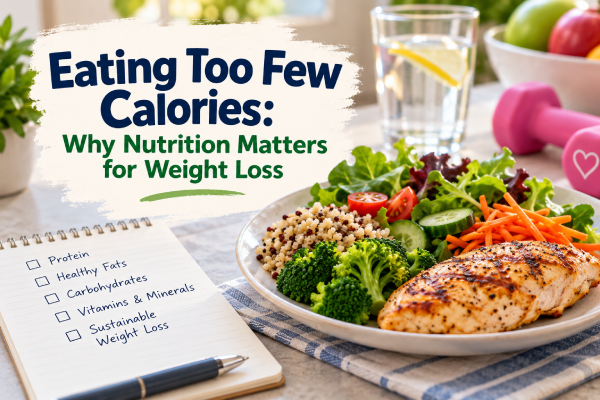
Eating too few calories may help you lose weight, but it can also make it harder to get the nutrients your body needs. When we’re trying to lose weight, it’s tempting to think that fewer calories will always produce better results. Unfortunately, weight loss isn’t quite that simple.
Your body needs more than a calorie deficit. It needs protein, healthy fats, carbohydrates, vitamins, and minerals to function properly.
The real goal should be to lose excess body fat while keeping your body healthy and strong.
The Problem With Cutting Calories Too Low
Weight loss generally occurs when you consume fewer calories than your body uses.
That sounds simple enough. But what happens when we keep reducing our calorie allowance to make the weight come off faster?
We may lose weight, but we also risk losing muscle and missing important nutrients.
Eating too few calories over time can contribute to:
- Muscle loss and weakness
- Fatigue and reduced energy
- Vitamin and mineral deficiencies
- Poor bone health
- Difficulty maintaining an adequate protein intake
- Increased risk of malnutrition
And here’s something worth remembering: You can be overweight and still be undernourished.
The number on the scale doesn’t tell us whether we’re getting everything our bodies need.
Protein: One of the First Things to Watch
Protein helps maintain muscles, repair tissues, and support many important functions throughout the body.
When we lose weight, we want to lose fat while preserving as much muscle as possible.
That’s especially important as we get older.
Our bodies naturally tend to lose muscle with age. Losing additional muscle during weight loss can make everyday activities more difficult.
Protein requirements depend on several factors, including body weight, age, activity, and medical conditions.
For generally healthy adults, a common starting recommendation is 0.8 grams of protein per kilogram of body weight daily. Some older adults and physically active people may benefit from higher amounts.
However, people with kidney disease or certain other health conditions may need different recommendations.
More protein isn’t automatically better. The goal is to get the right amount for your individual needs.
What Happens to Protein When Calories Drop?
Let’s look at an example.
Suppose someone needs 65 grams of protein each day.
Each gram of protein provides approximately four calories. That means 65 grams of protein supplies 260 calories.
Here’s how that protein fits into different calorie allowances:
| Daily calories | Calories from protein | Percentage |
|---|---|---|
| 1,800 | 260 | 14.4% |
| 1,500 | 260 | 17.3% |
| 1,200 | 260 | 21.7% |
| 1,000 | 260 | 26% |
Notice something interesting?
The protein requirement hasn’t changed. But as calories decrease, protein takes up a larger share of the daily allowance.
That leaves fewer calories for foods that supply other essential nutrients.
A higher protein percentage isn’t necessarily unhealthy. The concern is whether the overall diet provides enough nutrition.
Calories Do More Than Determine Your Weight
We often think of calories as something we need to limit.
But calories are energy, and our bodies need energy to survive.
Even while resting, your body uses energy to keep your heart beating, lungs breathing, and organs functioning.
Physical activity requires additional energy.
Your calorie needs depend on factors such as age, sex, height, weight, and activity level.
That’s why the same calorie allowance isn’t appropriate for everyone.
Someone who spends the day sitting may need fewer calories than someone who spends hours cleaning, gardening, or performing physical work.
But both people still need adequate nutrition.
Can You Feel Full While Eating Too Few Calories?
Absolutely!
Hunger isn’t a reliable measurement of nutritional adequacy.
Certain foods contain plenty of water or fiber and can help us feel satisfied without providing many calories.
Protein can also help us feel full.
That can be useful during weight loss. However, feeling satisfied doesn’t guarantee that we’ve consumed enough essential nutrients.
You might finish the day without feeling hungry and still fall short on protein, calcium, iron, or other nutrients.
That’s one reason tracking nutrition can be just as important as tracking calories.
Why Nutrition Becomes More Important as We Age
As we get older, our bodies often require fewer calories because of changes in metabolism, muscle mass, and physical activity.
However, our need for many essential nutrients remains the same.
Some nutritional needs may even increase.
Protein becomes particularly important for maintaining muscle strength. Calcium and vitamin D help support bone health.
This creates a challenge.
We may need fewer calories, but we still need nutrient-rich foods.
For older adults, losing weight too aggressively can make it harder to preserve muscle and bone health.
A slower approach may be more appropriate, especially when health conditions are involved.
How Low Is Too Low?
There isn’t one calorie number that works for everyone.
However, very low calorie allowances deserve careful attention.
The National Institute of Diabetes and Digestive and Kidney Diseases advises against eating fewer than 1,200 calories daily in its Diabetes Prevention Program guidance.
Some medically supervised weight-loss programs use lower calorie levels, but these require special planning and monitoring.
Even a calorie allowance above 1,200 may be too restrictive for some individuals.
The safest approach is to consider your personal energy needs, nutritional requirements, health conditions, and weight-loss goals.
If reaching your desired weekly weight-loss rate requires an extremely low calorie allowance, consider slowing your target rather than continuing to cut calories.
Weight Loss Calorie Calculator
How to Lose Weight Without Sacrificing Nutrition
A healthy weight-loss plan should provide enough nourishment while creating a reasonable calorie deficit.
Here are several ways to accomplish that:
- Choose a realistic weight-loss rate. Gradual weight loss is generally easier to maintain than rapid weight loss.
- Pay attention to protein. Include appropriate protein sources throughout the day.
- Choose nutrient-dense foods. Vegetables, fruits, whole grains, dairy or fortified alternatives, and suitable protein foods can provide important nutrients.
- Track more than calories. Look at protein, fiber, vitamins, and minerals when evaluating your diet.
- Include physical activity. Walking, housework, gardening, and other movement can help support health. Strength-building activities are particularly useful for preserving muscle.
- Adjust your goals when necessary. If your calorie allowance makes adequate nutrition difficult, consider a smaller deficit.
- Consider your medical needs. Kidney disease, diabetes, osteoporosis, and other conditions may require individualized nutritional guidance.
Remember, successful weight loss isn’t a race.
Introducing Our Daily Protein and Nutrition Calculator
We’re developing a new Calorie Crusaders calculator to help visitors better understand their daily nutritional needs.
The calculator will estimate protein requirements using factors such as age, body weight, and activity level.
It will also show how protein fits into a chosen daily calorie allowance.
Most importantly, it will help users recognize when a calorie target may be too restrictive to comfortably support their nutritional needs.
The calculator will provide educational estimates, not a medical diagnosis or a guarantee of nutritional adequacy.
People with medical conditions that affect protein or calorie requirements should follow their healthcare professional’s recommendations.
The Calorie Crusaders Bottom Line
It’s easy to become focused on the numbers when we’re losing weight.
We watch our calories. We watch the scale. And sometimes we become so determined to lose another pound that we forget what our bodies need along the way.
But the purpose of losing weight is to improve our health.
We don’t want to reach our goal weight only to discover that we’ve lost valuable muscle or neglected our nutritional needs.
The best calorie allowance isn’t necessarily the lowest one. It’s one that helps you lose weight while giving your body the nourishment it needs.
After all, we’re trying to get healthier, not just smaller!
Calorie Crusaders Disclaimer: This article is for educational purposes only and is not medical advice. Calorie and protein needs vary based on individual health conditions, medications, and other factors. Consult your healthcare professional or registered dietitian before making significant dietary changes, especially if you have kidney disease, diabetes, or other medical concerns.